  |
By Bryan Keefer
In a new ad entitled "Powerful," John Kerry levels some of the most misleading charges his campaign has made to date.
|
Kerry's ad features a graphic and narration both stating that "Drug companies got a $139 billion bailout." In a fact sheet released Tuesday in support of the ad, his campaign cites a report from the Boston University School of Public Health to back up its claim. But the study notes that the number is based on a calculation of the additional profits drug companies will make selling pharmaceuticals to Medicare patients over the next eight years, not the upfront subsidy implied by "bailout."
The ad also states that "They give CEOs big tax breaks for shipping our jobs overseas." Yet the tax breaks in question, according to a March article in the Wall Street Journal, provide incentives for companies to invest overseas - not tax breaks for individuals, as the invocation of CEOs implies. (The incentives in question allow US companies to pay less in taxes on income earned overseas when it is invested overseas.) Moreover, as the Journal pointed out, those incentives have been in place since the corporate income tax was first leveled in the early twentieth century, contrary to Kerry's implication that Bush created them.
It goes on to state that "The Saudi Royal family gets special favors, while our gas prices skyrocket." The Kerry ad cites a Reuters report from September 29, 2004, but that release refers only to the rising price of oil, making no mention of any "favors." Nor does the Kerry fact mention of what those special favors might be. This is simply an inflammatory attack designed to influence voters by appealing to negative perceptions of the Saudis. As the New York Times pointed out, this line of attack echoes other ad put out by independent groups, as well as Michael Moore's "Fahrenheit 9/11."
In this case, it's the deception that's powerful.
Update (10/14):A version of this post was included in our Philadelphia Inquirer column today.
[Email this to a friend] [Subscribe to our email list]
By Ben Fritz
In an attempt to use John Kerry's words against him, the Bush/Cheney campaign has taken two words uttered by him at Thursday's presidential debate and distorted them in a way that contradicts the Democratic presidential candidate's position.
The deceptive attack is best captured in a new ad released by the Bush/Cheney campaign, which features the following script:
He said he'd attack terrorists who threaten America. But at the debate, John Kerry said America must pass a "global test" before we protect ourselves. The Kerry doctrine: A global test.
So we must seek permission from foreign governments before protecting America?
A global test?
So America will be forced to wait while threats gather?
President Bush believes decisions about protecting America should be made in the Oval Office, not foreign capitals.
Kerry did say that he believes a preemptive war waged by the US should pass a "global test." But in context, his meaning was quite different than what the Bush campaign is claiming: "But if and when you do it, Jim," Kerry said to Jim Lehrer of PBS, the debate moderator, "you have to do it in a way that passes the test, that passes the global test where your countrymen, your people understand fully why you're doing what you're doing and you can prove to the world that you did it for legitimate reasons."
Clearly, Kerry meant that a President must be able to demonstrate to the world that the preemptive war is being waged for legitimate reasons, not that foreign governments must provide "permission."
In fact, Kerry said the exact opposite at another point in the debate. In his very first answer of the night, the Democratic candidate said, "I'll never give a veto to any country over our security."
The misleading quote isn't only being used in a Bush ad. The President has also made it part of his stump speech. Speaking October 1, the day after the debate, in Lehigh, Pennsylvania, he said, "One other point I want to make about the debate last night. Senator Kerry last night said that America has to pass some sort of global test before we can use American troops to defend ourselves. He wants our national security decisions subject to the approval of a foreign government."
The President has even gone so far as to call this out-of-context quote the "Kerry doctrine."
And Vice President Cheney made a similar accusation at a rally immediately following the debate. "[Kerry] says that in response to the question on preemptive action, he would support it as long as it passed some kind of global test," Cheney stated, adding soon thereafter, "[W]e're prepared to work to lead a coalition, but we will never submit to the objections of a few. We will never seek a permission slip to defend the United States of America."
Journalists should debunk this misleading attack, which only distracts from the substantive issues debated by the candidates.
Update (10/14):A version of this post was included in our Philadelphia Inquirer column today.
[Email this to a friend] [Subscribe to our email list]
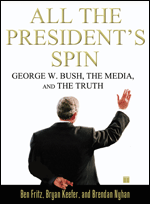
By Ben Fritz, Bryan Keefer, and Brendan Nyhan
The first presidential debate provided an opportunity to judge the candidates side by side. Absent in the tightly controlled format - and in much of the coverage afterward - was an assessment of the candidates' accuracy. There was much to assess. (Read the whole column in the Philadelphia Inquirer.)[Email this to a friend] [Subscribe to our email list]